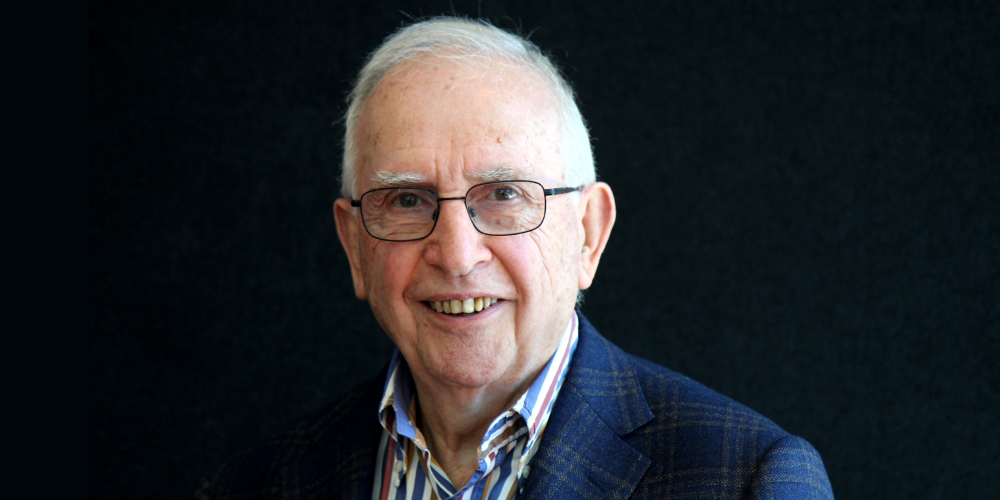
Best-selling author of 25 books, founding APS member, researcher, and social psychologist Hugh Mackay needs little introduction. Hugh has dedicated much of his writing career to the subject of kindness, which brought about two of his best-known books: The Kindness Revolution (2021) and The Way We Are (2024), and his latest book due for publication in 2027, Seven Keys to The Good Life. He insists that kindness is far more important than many people realise. In fact, he wants us to acknowledge that it’s the essence of our survival as a species.
In time for the launch of the newly developed APS Member Community Charter, a framework that features kindness and consideration as a core principle, Hugh explains why kindness is crucial to thriving communities.
Hugh says, “Now that the APS has wisely declared that kindness is one of the qualities to be nurtured in the APS community, we need to have conversations about what it is and how we make it happen.”
To begin these conversations and define what kindness is, Hugh says, we need to look at the history of humans and how we’ve survived when no other species of human has.
What is kindness, and why is it key to our sense of belonging?
“It's profoundly true that we are by nature communitarians – social creatures; herd animals. Psychologists know this but so, it seems, do archaeologists! I recently came across a report on a study by some British and German archaeologists working in Europe, who believe they've come up with the answer to a puzzle that existed for a long time. We know there were five or six species of human roaming our planet for between 200,000 and 300,000 years. The question is: what happened to the others (Homo Erectus, Neanderthals, and so on)? Where are they? There’s evidence in the fossil record that they existed. But why did we survive when they didn't? These archaeologists believe they've come up with the answer, which I find beautiful and central to our understanding of what it means to be human.
“Their answer is that only Homo Sapiens had developed the art of living in small, mutually dependent, self-sufficient communities – sharing resources, caring for the sick and wounded, and operating as small, cohesive social units. All species of humans were apparently tribal, but only Homo Sapiens had become communal. The conclusion from the research is that this is what saved us 42,000 years ago, when a catastrophic climatic event hit the planet Earth and wiped out all the other species. We were the only ones who survived because we were the only ones caring for each other in this more intimate, communal way.
"An archaeologist commenting on the research said that this was a case of ‘survival of the kindest.’ Another said it was our emotional vulnerability to each other that turned out to be our greatest strength. Because we were concerned about caring for each other, we protected each other and survived. That's the current theory, and I love it because it points to the skills we need to be true to the essence of our species – what US President Abraham Lincoln once rather poetically described as ‘the better angels of our nature’.
"The other critical point these the archaeologists made was that we had evolved into a ‘cooperative species,’ while the others were apparently more competitive. That view is confirmed by the neuroscientists who tell us they can find the cooperative centre in the human brain, but there’s no ‘competitive centres’ – that’s a socially conditioned response that’s not part of our essential nature.
"So we should not think of kindness as a nice thing to do to each other when we're in the mood to be kind. It’s more accurate, and more helpful, to think of kindness is a species survival skill. It's the crucial ingredient in the creation of cooperative, harmonious, sustainable communities, which is the only way our species has survived and the only way it will survive. Kindness, compassion, cooperation, tolerance, inclusiveness … all these qualities are essential to our survival.
"That brings us to the definition of kindness. If you think of humans as essentially social beings, that explains why, our deepest psychological need is to be taken seriously; to have a sense of acceptance and belonging. So I define kindness as anything we do to show other people that we take them seriously. In clinical psychology, quite apart from the skills of the therapist, there’s that powerfully therapeutic sense, for the client, that, for one hour a week, somebody is taking me seriously. I am being listened to, attended to, noticed, appreciated, acknowledged and included, I feel valued.
"In any social setting, of course, kindness can be demonstrated with a smile, a wave to a total stranger that you pass in the street, a comment about the weather to someone at a bus stop or helping a frail elderly person cross the street.
Perhaps the kindest thing we ever do to each other, professionally or personally is to listen.”
Feeling heard: How we show kindness in our communities
Hugh regards attentive, empathic listening as one of the greatest acts of kindness between humans, and he reminds us that active listening should not be reserved for those who we agree or align with, either.
“When we listen to another person we are saying, ‘I take you seriously enough as a person to listen to what you have to say. I might profoundly disagree with you, and we might be heading for a raging argument about what you're saying, but that's alright’. By the way, it’s important to note that we can argue kindly. We can discipline a child kindly. We can terminate someone's employment kindly. We can even terminate a relationship kindly. It's all a matter of demonstrating kindness by what we say and how we say it, that we take the other person seriously. 'We have to do this and it's unpleasant, but we can treat each other kindly.'
"Not listening to someone, or only half listening, says precisely the opposite: ‘I don’t take you seriously enough as a person to bother listening to you. I’m not even prepared to entertain your ideas.’
“Think of kindness as a unique form of human love. The original term was ‘lovingkindness.’ We've chopped it down, and we just say ‘kindness’ now. All forms of human love are wonderful, of course: romantic love, familial love, companionate love. But all of those forms of love have something in common, which is that they're all about our emotions. They're all about how we feel about each other. Even when we use love in more trivial settings, like,‘I love dogs,’ or ‘I love chocolate,’ or ‘I love that movie,’ we're talking about our emotional response to those things. But this is where kindness is unique. It’s possibly the loveliest thing to know about our species: we are capable of being kind to people towards whom we feel nothing. Kindness is not an emotional response to another person. Kindness is a human being true to their humanity.”
Striving for social harmony over isolation in a fragmented society
“Kindness is the essential ingredient in social harmony, and social harmony is vital to our survival as a species. That’s why I carry on a bit about kindness. I think it warrants a capital K. It is such a wonderful human quality. Because it’s actually in our DNA to cooperate, I think it’s fair to say that we are all born with the capacity to show kindness.
“The capacity is there, just like the capacity for language. But, like language, it has to be nurtured, encouraged, modelled and reinforced. About 250 years ago, Samuel Johnson wisely wrote: ‘Kindness is in our power, even when fondness is not.’ I think that's a brilliant insight. It’s true, isn’t it? We are indeed capable of showing kindness towards someone we have negative feelings towards. We can show kindness towards people we could never agree with about psychology, or music, or politics, or the raising of children, or the arts. We can, and often do, show kindness towards total strangers. And we don't qualify them for our kindness. We don't see a frail elderly person trying to cross a busy street and say, ‘Look, I can see you're in need of a bit of kindness, but first, I need to know how you voted in the Voice referendum. Where do you stand on nuclear power?’ No, kindness is indiscriminate.
“Of course there are plenty of unkind people in the world, but when people are unkind, surely, we have to say, ‘Well, this is a wounded person.’ Only wounded people behave badly, and only really badly wounded people behave really badly. It's all a question of what was nurtured, what was modelled in our formative years. I'm always trying to encourage families to put kindness on the agenda, to talk about kindness when the kids come home from school. Instead of always saying, ‘What did you learn today?’ we can ask, ‘Were you kind to anyone today, or was someone kind to you? Try making it one of the headlines of the day's news.”
Given we are a cooperative species, equipped for kindness; given our great need of each other, and how hopeless we are in isolation, Hugh believes one of the biggest contemporary questions for our society is this: “How come in 2026 in Australia, a society populated by human beings with such beautiful potential for social connection in our DNA, our number one public health issue is social isolation?
"The Ending Loneliness Together Coalition recently published some very good research, which showed that 51% of Australians report some loss of social connection, either through loneliness, social isolation, or both.”
Hugh believes a significant contributing factor to increasing social isolation is our shrinking households. In the past 100 years, he points out Australia’s population has increased five-fold, while the number of households has increased tenfold. The fastest growing household type in Australia is now the single-person household, already accounting for almost 30 percent of all households. If you put single-person and two-person households together, you’ve accounted for well over half of all Australian households. Not everyone who lives in a single-person household is socially isolated or lonely, of course, but as we approach the stage where every third household contains just one person, the increased risk of social disconnection is obvious. (Hugh also notes that while our households are shrinking, our dwellings are expanding, having more than doubled in size in the past 75 years. ‘We have become a nation of spare rooms,’ he says.)
A case for reconnecting with neighbours to strengthen community
Shrinking households are just one factor contributing to our loss of social connection, alongside fewer opportunities to encounter neighbours, partly due to almost universal car ownership.
“Most people live in drive-in, drive-out suburbs where you come and go by car. You may never see your neighbours, or you might just wave at the car, which is very different from stopping and having a chat on a footpath. Our increased busyness is also a potential barrier to social interaction and social harmony,” Hugh says, “as if being busy is a legitimate excuse for minimising social contact.
“In many ways, the neighbourhood is a test bed of our commitment to kindness as a way of life. This is where we are living among people we didn't choose. We have family, friends, and professional colleagues, and then we also have neighbours. It’s a separate category, and I think we have been neglecting that. Attention to neighbours – the care of neighbours – was central to our survival 42,000 years ago. We weren't just being kind and supportive to our family or to people we like, but to the community.
"And yet, today, especially in our major cities, you hear people say, ‘Oh, we don't know our neighbours.’ No one says that with pleasure or pride. They don't say, ‘I have achieved the situation I've been aiming for, for years. I can finally announce that I no longer know my neighbours. Isn't that wonderful?’ Of course not. It's a weird thing to say. You live right next door to someone, or just across the street. You're breathing the same air. You're walking the same footpath. ‘I don't know my neighbours’ is actually an admission of social failure. It’s a sad statement. But we can easily do something about it, and the first step is simply to introduce ourselves to our neighbours – not so we can become best friends, but simply because we’re neighbours."
Hugh also cites technology, especially social media, as another contributing factor to social fragmentation, isolation and loneliness.
“Information technology, and social media in particular, promised to make us more connected than ever before, and it has done that in a purely technological sense. But it has actually made it easier than ever before to stay apart. We know the crucial ingredient in human interaction is eye contact, yet we’re increasingly trading that off in favour of staring at a screen. It’s no surprise that the heaviest users of social media – 18-24-year-olds – are also the loneliest age cohort in our society.
"We now recognise loneliness and social isolation as a health issue because of all the health consequences that follow, including increased vulnerability to hypertension, inflammation, sleep disorders, and addiction. And social isolation is now also associated with reduced life expectancy. This is serious stuff, but it's not at all surprising when you think about the nature of our species,” he says.
“If people who belong to a social species are socially fragmented and socially isolated, of course they're going to have mental and physical health problems. A herd animal that's cut off from the herd is going to suffer. It's going to be in need of psychotherapy.”
The great antidote to social isolation and loneliness
Hugh believes it’s time to refocus on our oneness as humans, rather than over-emphasising on individuality.
“A more fragmented society inevitably leads to more individualism, resulting in the ‘Me culture’ now evident throughout Western societies. The ‘Me culture’ is characterised by an obsession with personal identity. Of course, a strong sense of personal identity is crucial to our mental health, but we’re now overplaying it. We’re putting more emphasis on personal identity than on our shared humanity. Of course, the most interesting thing about us – especially from the point of view of psychology – is our huge range of individual differences, but by far the most significant things about us is that we share a common humanity.
“Racial prejudice, religious prejudice, ethnic prejudice … all these things are signs that we haven't grasped what it means to say, ‘I’m human.’ Once we understand we’re all human, then we understand the need to cooperate, the need for social harmony, the need for kindness. The great antidote to social isolation and loneliness – and the bulwark against prejudice – is kindness, because kindness is the bridge to social connectedness. Even the smallest acts of kindness, now known as ‘microkindness’, create precious moments of connection.”
How psychologists and the APS can foster community with kindness
According to Hugh, psychologists are in a significant position to help with the urgent work of healing a society wounded by social fragmentation.
“As a profession uniquely placed to understand the nature of the problem, we have a special responsibility to help solve it – not only through the explicit healing work of psychotherapy but also through our personal example in the family, among friends and colleagues, and among neighbours. As members of a professional society – especially a society of psychologists – I believe we need to respond to the new Charter by fostering the idea of kindness towards colleagues. Here is an opportunity for us to develop a greater sense of collegiality – a greater sense of community – which will be good for the Society, but also for us as individual members. If we nurture a sense of community in the neighbourhood, it will become a healthier neighbourhood and we'll all benefit. Similarly, if we develop a sense of the APS as a community of psychologists powered by kindness, as well as by mutual interest and professional skills, we're all going to be the beneficiaries of that.
“Our profession, like all professions, has factions. We have Jungians, Rogerians, CBT practitioners. Some of our members think psychoanalysis is the way of the future; others think it’s a relic of the past. But to become a true community, a true intellectual community, we must be prepared to listen even to those whose views we will never accept. The key to listening is setting aside my own prejudices, my own background, my own worldview, and just for the moment, entering into yours. To borrow from Carl Rogers, the acid test of whether we're really listening to a colleague is asking yourself, ‘Am I running the risk of being changed by what I hear?’ And if I'm not running that risk, then I'm not really listening.
“Even if part of your brain is saying, ‘I know I'm not going to be changed by this because it's rubbish,’ another part of the brain needs to be more open, at least to the extent of saying, ‘I've got to imagine what it's like to be this person saying this. I've got to entertain these ideas before I am qualified to respond.’ You can still be kind, even while having radical, fundamental differences of professional opinion.”
Navigating differences of opinion in the profession
While differences of opinion exist in every profession, and in most relationships, Hugh urges us to keep them in perspective.
“Differences of opinion are just that: differences of opinion. That’s all they are, so what's the big deal? Differences of opinion don’t mean one of us is necessarily right and the other is wrong. A difference of opinion doesn't make us enemies. The difference is simply between our opinions on this one matter. We're still humans, and we're still interacting. We could probably agree warmly about test cricket or politics, or the significance of Shakespeare or something else, while disagreeing, for example, about our preferred approach to psychology. So what?”
Hugh reminds us that people’s inability to accept differences of opinion has led to the cruel and bizarre contemporary practice of ‘cancelling’ someone.
“The cancel culture is part of the ‘Me culture’, which leads us to lose sight of our essential humanity, our communality. Imagine saying, ‘Oh, I don't approve of what you said or what you did or what you stand for, so I'm going to pretend you don't exist’. Well, that's sub-optimal human behaviour, to say the least.
“Let’s wrap this up by returning to our personal responsibility to embrace kindness as a way of life. If you dream of a better society, one which is kinder, more compassionate, more tolerant, less violent, more cooperative, more inclusive, then the only way to make it happen is to live as if it's already that kind of society. Mahatma Gandhi said, ‘Be the change you want to see’. If enough of us live as if this is the kind of society we want it to be, that’s how change will come, whether we’re talking about the wider society or the Australian Psychological Society.”
You can read the newly developed APS Member Community Charter, and learn more about its core principles, including, kindness and consideration, here.
And, learn more about kindness through our series of APS & APS CPD Approved events, including the PsyBA-approved Supervisor training Master class: Compassion-focused supervision: Integrating compassion-focused approaches to supervision.