How IMEX is rewriting the rules of inclusive event design with the APS's Neurodivergent-Inclusive Event Guidelines, endorsed by the American Psychology Association.
When Oliver Bailey walks a trade show floor, he doesn't see a room full of stands and signage. He sees a sequence of decisions – about light, sound, movement, language and space – each one carrying a measurable consequence for the people inside it.
As the interaction design expert at IMEX, one of the world's leading trade shows for the meetings and events industry, Bailey has spent more than two decades applying human-centred design thinking to live experiences.
"We think of ourselves like city planners. You can't just build a whole new estate without doctors' surgeries, schools, parks – all the infrastructure to service the people. You have to do the same when you run a large event," says Bailey.
A key aspect to this human-centred design, he says, is considering how to make spaces and events more inclusive. This led IMEX to adopt the Australian Psychological Society's new Neurodivergent-Inclusive Event Guidelines – which have been co-endorsed by the American Psychological Association (APA) and are the only guidelines developed by psychologists and reviewed by neurodivergent people with lived experience.
"What our industry needed was some kind of work towards a standard – an agreement and accreditation where people can actually make a start, work towards [greater inclusion] and then get independently certified. It's not so you can say, "'We're great. We're certified,' but to wipe out all of the virtue signalling of events that weren't truly inclusive, but were claiming that they were."
Enhancing the experience
IMEX runs two major annual shows: one in Frankfurt and one in Las Vegas. With 13,500+ participants at its latest Frankfurt edition alone, the shows have evolved along with the scale. Bailey recalls the moment the conversation shifted.
"We started seeing hashtags like '#IMEX-hausted'. People were [coming to our events and] using exhaustion as a badge of honour. That's a real red flag for organisers, because we don't want people to go home broken. We want the experience to be really positive."
That concern for energy and wellbeing eventually led IMEX to zero in on the experience of neurodivergent attendees.
"We were saying, 'How would this environment be for somebody with autism?' And we started thinking about how we could educate people and make more provisions ourselves."
Bailey is candid about the limits of where IMEX found itself at that point.
"We lacked any kind of rigorous scientific or academic underpinning. We were largely using common sense and anecdotal feedback."
This is precisely the gap the APS Neurodivergent-Inclusive Event Guidelines were designed to fill.
When the APS's team of psychologists began examining what already existed in the market, they found things like checklists, toolkits and guides. While these were well-meaning resources, they were not grounded in psychological science.
Many of these resources made the critical error of treating neurodivergence as a single, uniform experience, as if autism, ADHD, dyslexia, dyscalculia, dyspraxia and Tourette syndrome all produced identical responses to the same environment.
"You can say, 'We're neurodivergent inclusive,' and they might just have a very stark room in a corner with bean bags, miles away from the event, and think that's going to work. That's not what we mean by inclusive. Inclusive is designing things from the very beginning, at the design stage," says Bailey.
"There's a UX designer called James Baverstock who said: 'You can't make blueberry muffins by pushing the blueberries in at the end. You have to think about things from the start.'"
The APS Guidelines do exactly that. Developed by psychologists, reviewed by neurodivergent people with lived experience, and endorsed by the APA, they ground every recommendation in psychological theory and peer-reviewed evidence.
Crucially, they do not simply tell event professionals what to do. They also explain why. This convergence of scientific rigour and lived experience is what makes them unique.
How the guidelines helped IMEX
Bailey is keen to dispel the myth that meaningful inclusion is expensive.
"Quite often it involves not doing something, which actually saves money," he says. "Thinking about light levels and turning a light up or down, doesn't necessarily cost anything at all. You don't have to throw a load of money at staging and styling to get a really nice, well-functioning tranquil space."
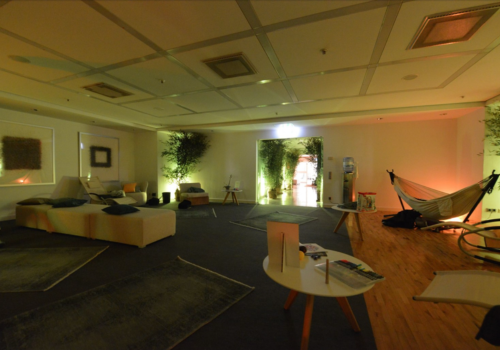
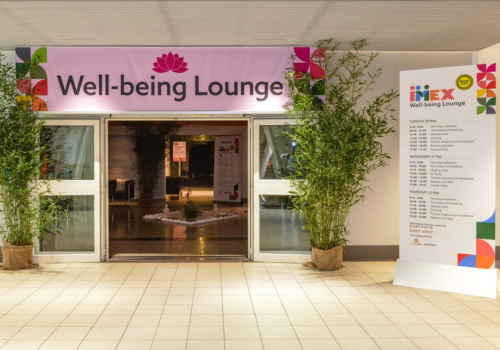
At Frankfurt this year, IMEX created a dedicated quiet roomadjacent to its wellness offering. Low light, low sensory, stocked with weighted blankets and fidget tools, it was staffed to ensure it remained a genuine retreat, not a place to make work calls.
Beyond dedicated quiet spaces, the design thinking ran through every element of the event. IMEX eliminated raised stages at the Inspiration Hub, the show’s learning zone, a decision with both physical accessibility and psychological dimensions.
"Speakers are on the same level as everybody. They're not saying, 'Look at me, I'm brilliant.' They're saying, 'I'm the same as you.'"
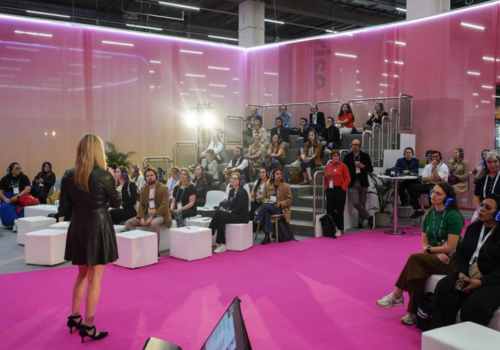
Image: Inspiration Hub at IMEX Frankfurt 2026
They also offered tiered seating, high tables for those who prefer to stand and soundproofed pods open to anyone who needed to decompress.
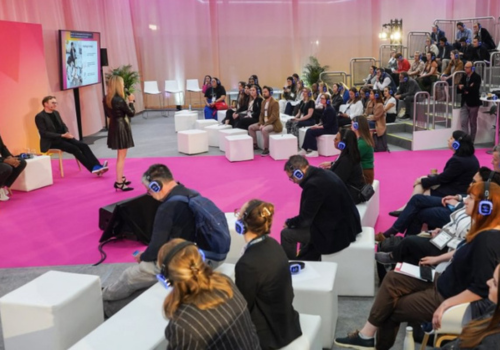
Image: Inspiration Hub at IMEX Frankfurt 2026
The program itself was also deliberately non-prescriptive.
"People could choose whatever they want to go to – it's their own adventure. That freedom has been really vital for neurodivergent people, so they can manage their own time and not be worried about sitting through another two hours of something."
Some of the most innovative solutions came from within the IMEX team itself. One staff member, who had been diagnosed with ADHD, suggested placing QR codes on the backs of toilet doors, reasoning that when someone needs to escape an overwhelming environment, the bathroom is often where they instinctively go.
"She said, 'You can put a sign there saying: 'You don't have to sit here. We've got a whole area where you can relax and take as much time as you want.'"
The QR code linked to a navigation tool using Bluetooth beacons that guided attendees directly to the tranquil space from wherever they were in the venue.
"That little bit of brilliance came from somebody who has first-hand experience of being overwhelmed at a trade show," says Bailey. "It can be really beneficial to involve the people with their own superpowers and insights."
The Certification process
The APS Guidelines are freely available to all event professionals globally and include a three-tier endorsement pathway that provides independent certification for events that meet the standard.
|
Level
|
|
Focus
|
Summary
|
Key Features
|
|
Level I: Tranquillity Room
|
|
Foundation of inclusivity
|
Creates a baseline inclusive environment with a dedicated quiet retreat for attendees needing to step away from sensory demands.
|
Low lighting and comfortable seating; clear communication about the room's purpose and location; no-talking policy to maintain a peaceful environment.
|
|
Level II: Sensory Room + Sensory Tools
|
|
Enhanced sensory support
|
Builds on Level I with a sensory space designed to meet a broader range of needs, helping neurodivergent individuals regulate and feel comfortable
|
Everything in Level I, plus: fidget items, stress balls and weighted blankets; varied seating for movement and comfort; noise-cancelling headphones or earplugs; calm, low-stimulation decor
|
|
Level III: Comprehensive Neurodivergent Accommodation
|
|
Comprehensive inclusivity
|
A fully neurodivergent-inclusive event, integrating inclusivity into every stage of planning, execution and feedback
|
Everything in Levels I and II, plus: clear pre-event communication including virtual tours and detailed schedules; flexible programming with frequent breaks and shorter sessions; staff training to recognise and support neurodivergent attendees; inclusive communication and accessible materials
|
IMEX Frankfurt 2026 has completed Level III (Comprehensive) endorsement – the first global trade show to achieve this certification.
Bailey said IMEX pursued the highest level of Certification in a deliberate effort to push themselves beyond what they were already doing.
The certification process examined everything from the tranquil space through to signage language, pre-event communications, catering, furniture and the sensory qualities of marketing materials.
It also got IMEX thinking about the very little things that might have overwise gone under the radar.
"We have lanyards with little clips, but quite often they have a swivel attachment, so the badges spin around and can squeak a little bit. If you get 13,500+ of those all in a room together, all swiveling around and squeaking, some people are really sensitive to those kinds of frequencies."
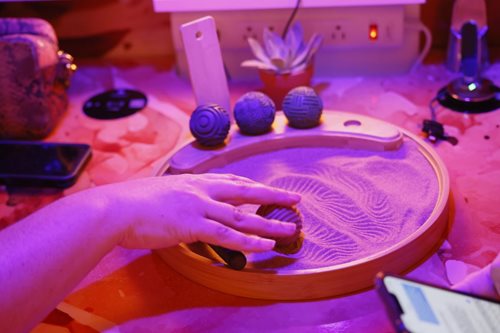
Image: The Resilience Room powered by Hello! DMC at IMEX America 2025
For Bailey, independent certification is the mechanism that closes the gap between claiming inclusion and demonstrating it.
"The neurodivergent community can then make an informed decision about whether they want to attend an event – is it for me, am I going to have a good time, or am I going to struggle?"
The commercial case is equally compelling, with 15-20% of an event audience being neurodivergent. That's up to 200 people at a 1,000-person event. According to industry research, 85 per cent respondents said that an event's explicit provision for neurodivergence directly influenced their decision to attend.
Plus, Bailey notes that these changes tend to benefit all attendees, not just those who are neurodivergent.
"If we have a lot of extra seating, quiet spaces, soundproof pods – everybody uses those, but people use them for different reasons. People can use their devices in there, or just shut their eyes, or make a phone call. But for some people, it's absolutely essential."
The relationship between psychologists and event professionals
The APS Guidelines carry a broader ambition beyond any single event or endorsement. They represent a proof of concept: that psychological science has direct, practical application in industries far beyond clinical settings.
"I would keep a permanent line open to as many psychological professionals as I can," says Bailey. "There's so much need for their expertise in the world of event design – and not just events. Escape rooms, museum exhibits, theme parks, immersive experiences. The experience economy is growing exponentially, and there has probably never been a better time for a psychologist to be more useful than they are right now."
The long-term vision for the Guidelines is for psychological bodies around the world to join the endorsement framework, establishing a recognised international standard for neurodivergent-inclusive event design.
IMEX's adoption is an early and important signal that the industry is ready.
For any event professional wondering where to begin, Bailey's advice is simple: "Just make a start. You'd be quite surprised how much you can do with very little. And if you need guidance on where to go from there, reach out to the APS for advice on organisations that can help you on your journey."
The APS Neurodivergent-Inclusive Event Guidelines are available now. They are the only guidelines developed by psychologists and reviewed by neurodivergent people with lived experience, and are co-endorsed by the Australian Psychological Society and the American Psychological Association. To learn more or begin your endorsement journey, reach out to the APS for advice. Contact: [email protected]