Australia's first Indigenous psychologist, Professor Pat Dudgeon AM FAPS, reflects on her pathway into the profession and highlights some of the career moments she's proudest of, such as the creation of the Social and Emotional Wellbeing model to support strong Indigenous mental health.
I am from the Bardi people from the Kimberley, however I grew up in Darwin, so I always say that part of my heart belongs there as well.
It was a hard start to life for many of us at the time. We were navigating a sense of alienation and marginalisation, and many of us grew up quite poor. I didn't think university was on the cards for me.
However, I was always academically oriented and despite leaving school at 15 to work. Later in my life I had the opportunity to move to Perth and study as a mature-age student. This was the first step towards a professional life where I knew I could make a strong impact for my community.
I chose psychology because I wanted to help people – I'm sure that's why most of us do this work. However, the moment I enrolled, I felt a disconnection. The psychology I was being taught was very white, middle-class and Western.
It was the 1980s and it felt like there was no room for people of other cultures. At that time, Aboriginal and Torres Strait Islander advancement was viewed primarily through an economic lens; there was very little interest in mental health.
I studied anthropology as my minor and enjoyed that more because it was respecting cultural difference, looked at concepts like ethnocentrism and valued Aboriginal culture. But I stuck with psychology, perhaps subconsciously realising that in order to change the system, I'd need to do so from the inside.
After graduating, I discovered I was the first Indigenous person to graduate in the field of psychology in Australia. If I'd known this at the time, I might have been paralysed by the pressure.
For some time after this, I worked in the education space – I headed up a Centre for Aboriginal Studies at Curtin University – but I was pulled back into the world of psychology when I came across a journal called Black Psychology created by African Americans in the US.
It felt like a revelation. For the first time, I saw someone totally dismiss the Western paradigm and lift up out of it.
This exposure gave me the confidence that we could develop our own concepts of Indigenous wellbeing and selfhood, and that sent me on a completely new pathway – one that I am still walking down today.
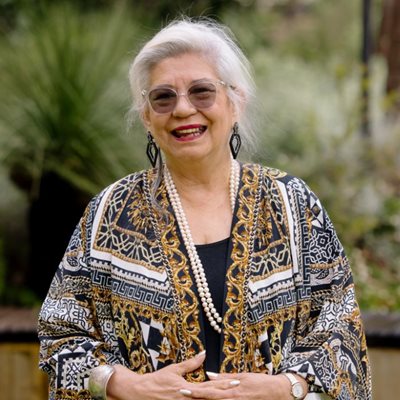
Image: Pat Dudgeon AM FAPS
The Social and Emotional Wellbeing (SEWB) Framework
As I moved through my career in psychology, I eventually ended up co-convening the APS interest group focused on Aboriginal and Torres Strait Islander issues.
We spent years advocating for cultural awareness within the discipline and for the recognition and respect of emerging programs from Aboriginal and Torres Strait Islander communities.
A significant turning point was the publication of the Working Together book, which was an important resource designed to improve cultural awareness and provide a comprehensive guide to Aboriginal and Torres Strait Islander mental health and wellbeing.
The first edition, funded by the government, saw 50,000 copies taken up within two months. We worked incredibly hard on it – it was a labour of love – bringing together Indigenous and non-Indigenous writers to tackle different facets of mental health.
By the second edition, we ensured that Indigenous knowledge and authorship were at the very core.
It was through this work that we introduced the Social and Emotional Wellbeing (SEWB) concept.
A group of Indigenous psychologists, including myself, developed the diagram that many of you know today (see below). We drew inspiration from the Ways Forward report and the first National Strategic Framework for Aboriginal and Torres Strait Islander Mental Health and Social and Emotional Wellbeing framework, looking for a way to put these ideas together so they made sense for our own people.

The SEWB model is a holistic, multi-dimensional concept of wellbeing. Crucially, it takes into account the impacts of the history of colonisation.
For so long, the discipline told us, "Don’t worry about the past; we are dealing with the here and now". But we realised that you cannot conceptualise an Indigenous selfhood without acknowledging that history – The invasion, the Stolen Generations, the struggle to reinstate culture and the fact that people carry their culture all around them.
In this paradigm, the 'self' is made up of different domains:
- Physical and mental wellbeing: Our physical self and our mental self.
- Connections: To family, community, culture, Country and spirituality.
- Determinants: Social, historical and cultural factors that surround these domains.
I remember presenting this to a big conference for Indigenous social and emotional wellbeing workers. Our mob doesn’t suffer fools gladly, so it was a good test about whether the model resonated with them, but they loved it. We presented the model over many forums afterwards and since then, it has gone like wildfire – moving from clinical programs into national policy.
I don’t just see SEWB as a model. To me, it’s a whole paradigm. It’s a way of conceptualising an Indigenous selfhood that the mainstream discipline just didn't have a place for when I was starting out.
In the Western way of thinking, there was this notion that we are all these concrete units – human beings existing without a history or a societal milieu. But for our people, you’re part of a big web of history, relationships and the environment.
In this paradigm, we look at the self through different domains. There is the body and the mental self, but there is also that vital connection to family, community, culture and Country. And I always make sure to mention that there is a spirituality connection in there as well. We carry our culture and our ancestors' stories with us.
I’ve often been asked about the connection to Country domain, and whether that’s strictly an Indigenous thing. I remember talking to a Gamilaroi psychologist about this, and they put it so well.
The Gamilaroi psychologist said: "We are all children of this planet. When any human being needs to heal, or find solace and regroup, they don’t usually head for the middle of a city – they go into nature. When you stand on the earth and dig your toes into the soil, you’re connecting to Country."
When I heard that, I thought: "This is true". If we see Country as a part of who we are, we become a lot more conscious about protecting our lands, the flora and fauna, the waterways and skies instead of just exploiting them.
Reimagining research: relationality and empowerment
For me, the SEWB model is part of a much broader effort to challenge the hegemony of Western psychology and make a space where Indigenous knowledge can breathe.
It has also informed my work in research methodologies. I’ve always had a love for qualitative research because it allows for relationality. We don't just treat people like big bottles of information where you just take the top off and extract what you want.
Instead, we prioritise the collective. When we do research, we don't sit in an office and write papers in a vacuum. We go out, meet stakeholders and develop genuine relationships.
That relationality is vital. We ensure there is strong co-design, treating participants as co-researchers because we are about privileging and nurturing Indigenous knowledges.
This means:
- Accountability: Having strong Aboriginal advisory committees overseeing the research.
- Reciprocity: Circling back and giving that information back to the group afterwards (without breaching any confidentiality).
- Diverse communication: Using different modes of communication, like paintings or pictures, as part of the feedback.
One of my biggest projects where this really came to the fore was the report on suicide prevention. For too long, suicide was looked at as just a clinical issue.
However, by using the SEWB lens, we could show it is also a consequence of colonisation, intergenerational trauma and current disadvantage. It’s about looking at the whole picture.
It’s been brilliant to see how the psychology discipline has changed and started to include these concepts in the mainstream. We’ve gone from using strictly British or American texts to seeing Indigenous psychology included as a core chapter in Lorelle Burton’s Introduction to Psychology, 6th edition.
This shows that the profession is finally expanding and including Indigenous people and our ways of knowing and healing, and that's something I'm really proud to have been a part of.
The path forward
Despite the ongoing challenges for Indigenous communities, I am optimistic.
In 2013, we started the Australian Indigenous Psychology Education Project (AIPEP), where we developed frameworks for increasing Indigenous students in psychology, including Indigenous Studies into the curriculum and supporting professional development.
When we revived AIPEP recently, the response was overwhelming: over 80% of schools of psychological science in Australia have signed up.
I was astonished by this response and, initially, wondered why there was such a profound shift. I soon realised a new group of progressive educators has come into leadership positioned – people who want the discipline to be inclusive and enriched by First Nations culture.
Our work is also expanding internationally. We are connecting with an Indigenous task force within the APA and building bonds with scholars from other settler countries – Native Americans, First Nations people from Canada and Māori from New Zealand.
To my psychology colleagues, I'd leave you with this message. By embracing a national consciousness that includes Indigenous history, we are all enriched. We no longer have to live in a state of cultural bereavement, but can instead walk forward together.
Resource list:
Professor Pat Dudgeon AM FAPS is a Bardi woman from the Kimberley in Western Australia and is Australia’s first Indigenous psychologist. She is a Research Fellow at the School of Indigenous Studies at the University of Western Australia, Lead Chief Investigator of Transforming Indigenous Mental Health and Wellbeing, and Director of the Centre of Best Practice in Aboriginal and Torres Strait Islander Suicide Prevention.
She was a board member of the Australian Indigenous Psychologists Association and of Gayaa Dhuwi (Proud Spirit) Australia, as well as participating in many national policy bodies such as Co-Chair of the national ministerial Aboriginal Torres Strait Islander Mental Health and Suicide Prevention Advisory Group.
Professor Dudgeon was formerly a Commissioner of the Australian National Mental Health Commission and has held many leadership positions such as leading the Aboriginal and Torres Strait Islander Suicide Prevention Evaluation Project (ATSISPEP) and leading the Centre for Aboriginal Studies at Curtin University for 19 years. She has been recognised for her work by various awards including Fellowships at the Australian Academy for Health and Medical Sciences and the Australian Psychology Society, and a Deadly Award for Health. She is also the Co-Chair of the APS Indigenous Taskforce.